
Moving to Murrieta, California? Learn About the City, Its History & Growth
If you are considering moving to Murrieta, California, one of the best ways to understand the city is to know a little about where it came from.
Murrieta may look like a modern Southern California city today, with neighborhoods, shopping centers, hospitals, parks, schools and busy roadways, but it has a much deeper history than many people realize.
I have lived in Murrieta since 1982, and I can tell you firsthand that this city has changed dramatically. When I moved here, Murrieta still felt like a very small town. Today, it is one of the major communities in Southwest Riverside County, yet there are still places where you can see pieces of the Murrieta I remember.
That combination of small-town roots and modern-day convenience is one of the things that makes Murrieta so interesting.
Where Did the Name Murrieta Come From?
Murrieta was named after the Murrieta family.
In 1873, Esequial Murrieta purchased approximately 52,000 acres in the area. He intended to move his sheep ranching operation here from Central California, but instead returned to Spain. His younger brother, Juan Murrieta, took over the property and brought an enormous flock of approximately 100,000 sheep into the valley. Murrieta
At the time, the valley looked nothing like the Murrieta we know today.
It was largely open land filled with grasses, oak trees, sycamores and natural hot springs. Ranching and agriculture would eventually play a major role in Murrieta's development.
Murrieta's History Goes Back Much Further
The Murrieta area's history actually began long before the Murrieta family arrived.
Native American communities lived throughout the Murrieta and Temecula valleys for thousands of years. City historical documents identify the Payómkawichum, commonly known today as the Luiseño people, as early inhabitants of the area. Several villages and culturally important locations existed within what is now Murrieta. Murrieta
Later, during the Spanish and Mexican periods, lands throughout the valley were associated with missions and large ranchos, including Rancho Temecula, San Jacinto Rancho and Rancho Santa Rosa. Murrieta
So when we talk about Murrieta's history, we are talking about a story that spans far more than just the modern city.
The Railroad Helped Create Murrieta
One of the most important events in Murrieta's early growth was the arrival of the railroad.
In the early 1880s, railroad tracks were constructed through the valley, connecting the area with larger transportation routes.
The Temecula Land and Water Company purchased the future Murrieta townsite in 1884, subdivided the land and began promoting the area to new settlers. Murrieta
By 1885, the Murrieta train depot had been built and a community began growing around it.
Land was inexpensive by today's standards. The City of Murrieta notes that pioneer families were being attracted by advertisements for land selling for as little as $5 an acre. Murrieta
Imagine that today!
By 1890, Murrieta had grown to a population of approximately 800 people, and the railroad was central to the town's economy and activity. Murrieta
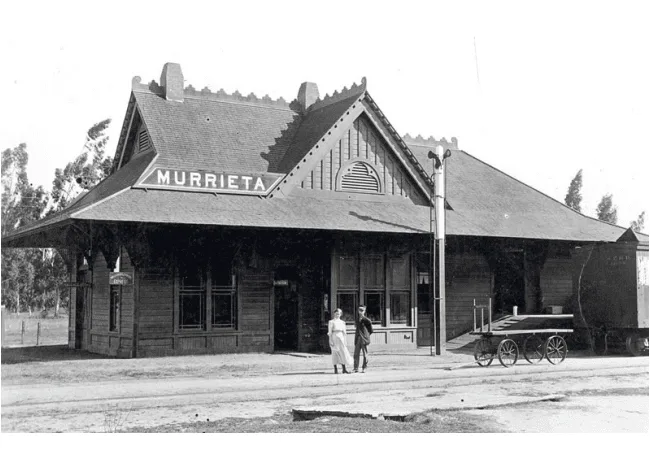
Old Town Murrieta Began Around the Railroad
What we now know as Historic Downtown Murrieta or Old Town Murrieta developed around the railroad depot.
Hotels, businesses and homes followed.
One of the early gathering places was the Fountain House Hotel, located across from the depot. It became an important social center for the community. Murrieta
Today, Old Town Murrieta still gives residents and visitors a glimpse into that earlier period.
You can find older buildings, restaurants, local businesses and community events in an area that feels very different from Murrieta's newer residential neighborhoods.
For people relocating to Murrieta, I always think Old Town is worth exploring because it reminds you that Murrieta was a community long before today's subdivisions and shopping centers appeared.
Farming and Ranching Shaped Murrieta
For much of the twentieth century, Murrieta was an agricultural community.
Farmers grew crops such as:
- wheat
- barley
- oats
- potatoes
- alfalfa
- vegetables
- grapes
- olives
- cherries
- pears
- apples
- figs
- nectarines
Large grain fields once covered areas that today contain neighborhoods, roads and businesses. Murrieta
Murrieta was also known for ranching and, during the 1960s, became known for breeding racehorses. Murrieta
You can still see remnants of that rural history in areas around Los Alamos Road, the western foothills and the Santa Rosa Plateau area, where larger properties and open spaces give a very different feeling from central Murrieta.
Murrieta Hot Springs Put the Area on the Map
Another fascinating part of Murrieta's history involves its natural hot springs.
The Murrieta Hot Springs Resort became well known throughout Southern California during the first half of the twentieth century.
Visitors traveled to Murrieta for the natural mineral springs, resort facilities and relaxing atmosphere.
The Murrieta Hot Springs property included pools, lodging and recreation facilities and became one of the area's best-known destinations. Murrieta
The hot springs remain an important part of Murrieta's identity today and are one more reminder that people were traveling to this valley long before the city's modern growth began.
When Did Murrieta Become a City?
This is one of the most common questions people ask:
When was Murrieta incorporated?
Murrieta officially became a city on July 1, 1991.
Residents had voted overwhelmingly in favor of cityhood in November 1990. Murrieta
At the time of incorporation, Murrieta already had more than 24,000 residents.
That is remarkable when you consider that the city's estimated population in 1980 had been only about 2,200 people. Murrieta
That gives you an idea of just how rapidly Murrieta changed during the 1980s.
Why Did Murrieta Grow So Quickly?
There were several reasons, but improved freeway access was a major factor.
During the 1980s, improvements to Interstate 15 and Interstate 215 made Murrieta much more accessible to employment centers in San Diego County, Orange County and other parts of Southern California.
At the same time, home prices in Murrieta were much more affordable than many coastal communities.
Families discovered they could purchase newer homes, often with more space, while still being within commuting distance of larger employment areas.
That helped fuel a dramatic population increase. Murrieta
Those same factors continue to influence people considering moving to Murrieta today.
Murrieta Created Its Own Police Department
Soon after becoming a city, Murrieta began establishing more local control over its services.
The Murrieta Police Department was established in 1992, giving the new city its own police force rather than relying solely on the Riverside County Sheriff's Department. Murrieta
Murrieta also assumed control of the local fire protection district in 1993. Murrieta
These developments were important steps in Murrieta becoming the full-service city residents know today.
Murrieta's Fire Service Actually Predates the City
Murrieta's firefighting history goes back much further than incorporation.
Residents voted to create the Murrieta Fire Protection District in 1947.
Members of the community donated $1,400 to purchase a fire truck, and the original department consisted of ten volunteers. During that first year, firefighters were summoned using the bell at the Methodist Church. Murrieta
I love details like this because they show just how small and close-knit Murrieta once was.
What Is Murrieta Like Today?
Today's Murrieta is dramatically different from the farming and railroad town of the past.
The city now offers a wide variety of residential neighborhoods, shopping centers, restaurants, medical facilities, parks, trails, schools, recreation programs and employment areas.
Yet Murrieta has managed to maintain several different personalities within one city.
You have:
- Historic Downtown Murrieta with its older buildings and local businesses.
- Alta Murrieta, one of the city's established residential areas.
- West Murrieta, with neighborhoods closer to the Santa Rosa Plateau and foothills.
- Central and East Murrieta, with newer neighborhoods, shopping and access to major roadways.
- La Cresta and nearby rural areas, offering acreage, equestrian properties and a completely different lifestyle just outside the more suburban portions of the city.
That variety is one of the reasons people researching where to live in Murrieta can find so many different options.
Murrieta's Location Is a Big Advantage
Murrieta is located in Southwest Riverside County, immediately north of Temecula.
Its location puts residents close to:
- Temecula
- Wildomar
- Menifee
- Lake Elsinore
- Winchester
- French Valley
- Canyon Lake
- the Temecula Valley Wine Country
Murrieta also sits along both the I-15 and I-215 corridors, making it an important crossroads for Southwest Riverside County.
For people relocating from San Diego, Orange County, Los Angeles County or other parts of Southern California, location is often one of the first reasons Murrieta gets their attention.
Parks and Outdoor Recreation
Murrieta offers numerous parks, sports fields, recreation areas and trails throughout the city.
Residents are also close to some exceptional outdoor destinations, including the Santa Rosa Plateau Ecological Reserve, nearby hiking areas and regional trails.
That ability to have suburban conveniences while still being close to hills, open space and outdoor recreation is part of Murrieta's appeal.
Shopping, Restaurants and Everyday Conveniences
Murrieta has grown substantially in terms of shopping and services.
Residents have access to grocery stores, retail centers, restaurants, medical offices and everyday services throughout the city.
Nearby Temecula expands those choices even further, including larger shopping centers, restaurants, entertainment and wine-country destinations.
One of the advantages of living in Murrieta today is that residents generally do not need to leave Southwest Riverside County for most everyday needs.
Healthcare in Murrieta
Healthcare has also become an important part of the local economy.
Murrieta and the surrounding area offer hospitals, medical offices, specialists, urgent care facilities and other healthcare services.
That is a tremendous change from the Murrieta I remember decades ago and another sign of how much the city has matured.
Is Murrieta Still Growing?
Yes, although today's growth looks different from the explosive expansion of the 1980s and 1990s.
Murrieta continues to add housing, businesses and services, but the city is now much more established.
Instead of being thought of primarily as a distant bedroom community, Murrieta has increasingly developed its own employment, healthcare, retail and business base.
That is an important distinction for anyone researching whether Murrieta is a good place to live.
What Makes Murrieta Different?
For me, one of the most interesting things about Murrieta is that you can still find traces of almost every period of its history.
You can drive through Old Town and see reminders of the railroad era.
You can travel toward the western side of Murrieta and see the hills and open spaces that shaped its ranching history.
You can visit neighborhoods built during the huge growth periods of the 1980s, 1990s and 2000s.
And you can explore newer developments that show where the city is headed next.
Murrieta is not simply a collection of newer subdivisions.
There is a story behind the city.
Frequently Asked Questions About Murrieta, California
When was Murrieta founded?
The modern town began developing in the 1880s, particularly after the railroad arrived and the Temecula Land and Water Company began subdividing the Murrieta townsite. The first Murrieta post office opened in 1885. Murrieta
When did Murrieta become a city?
Murrieta officially incorporated on July 1, 1991, after voters approved cityhood in November 1990. Murrieta
Who was Murrieta named after?
Murrieta was named after the Murrieta family, whose large landholding and sheep-ranching operation helped shape the valley beginning in the 1870s. Murrieta
Why did Murrieta grow so quickly?
Improved access to the I-15 and I-215 freeways, relatively affordable housing and migration from San Diego and Orange County contributed significantly to Murrieta's rapid growth beginning in the 1980s. Main Street Murrieta
Is Murrieta in San Diego County?
No. Murrieta is located in Riverside County, although it is relatively close to the San Diego County line.
Is Murrieta part of the Temecula Valley?
Murrieta is commonly considered part of the broader Temecula Valley/Southwest Riverside County region, along with Temecula and surrounding communities.
Is Murrieta an old city?
Murrieta has roots dating to the nineteenth century, but it did not officially incorporate as a city until 1991.
Does Murrieta still have a historic downtown?
Yes. Historic Downtown Murrieta, often referred to as Old Town Murrieta, preserves part of the city's original commercial and residential area.
Considering Moving to Murrieta?
If you are thinking about relocating to Murrieta, learning the history helps explain why different parts of the city feel so different from one another.
Murrieta has evolved from Native American lands and Spanish ranchos to sheep ranching, railroad settlement, farming, hot springs tourism and eventually one of Southwest Riverside County's major residential communities.
And although Murrieta has grown tremendously, I still see pieces of the small town I moved to in 1982.
That history, combined with today's neighborhoods, schools, parks, shopping, medical facilities and location, is what makes Murrieta such an interesting place to explore.
Whether you are simply researching what it is like to live in Murrieta, California, planning a visit or seriously considering making Murrieta your next home, I hope MurrietaLifeGuide.com helps you learn not only where things are—but also why this city became what it is today.
Explore more: Things to Do in Murrieta | Murrieta Neighborhoods | Murrieta Schools | Local Events | Restaurants | Parks | Murrieta Hot Springs | Living in Murrieta Guide
Considering a Move to Murrieta?
Whether you are just starting to research the area or ready to start looking at homes, Laura Holbert and Cheryl Shadden of Team Integrity Realty can help you find the right fit in Murrieta and Southwest Riverside County. With decades of combined experience and deep local knowledge, they know the neighborhoods, schools and lifestyle firsthand.
Laura Holbert · Broker, CA DRE #01932682
Cheryl Shadden · CA DRE #01935462
Team Integrity Realty · 37290 Los Alamos Rd. Murrieta, CA 92563